Digital Products Available Globally | Physical Products currently Shipping to USA, Canada, UK, EU, AU & NZ. ✨ Introductory SALE across all products!


The Exhausted Parent’s Guide to Surviving the First Month With a New Puppy
You are currently staring at a cold cup of coffee, wondering where your peaceful life went. Your hands are covered in tiny, red scratches from needle-sharp teeth. You love this little furball, but you are also profoundly, deeply exhausted.
If you are frantically searching for advice on surviving the first month with a new puppy, take a deep breath. You are not failing, and you are not alone in feeling this way. What you are experiencing is completely normal.
The internet loves to show us perfectly curated highlight reels of sleeping puppies and matching aesthetic collars. It rarely shows the reality of standing in the yard at three in the morning in the freezing rain.
We need to strip away the glossy filters and talk about the actual reality of puppy parenting. This is not about teaching complex tricks or having a perfectly obedient dog by week four. This is about establishing a foundation, protecting your sanity, and getting through the hardest transition period.
Table of Contents
The Emotional Toll of Surviving the First Month With a New Puppy
Nobody adequately warns you about the “puppy blues.” It is a very real, very overwhelming feeling of regret and anxiety that hits right after the initial adrenaline fades. You might actually find yourself crying on the kitchen floor, and that is okay.
When you bring a baby animal into your home, your entire routine is instantly shattered. Your sleep is broken, your schedule is dictated by a tiny bladder, and your anxiety is on high alert. You are constantly watching the floor for accidents or choking hazards.
Surviving the first month with a new puppy requires you to radically lower your expectations for yourself. The dishes might pile up in the sink, and your inbox might go unanswered for a few days. The priority right now is not maintaining a perfect house; it is simply surviving the transition.
We often put immense pressure on ourselves to have the perfect, well-behaved companion immediately. However, canine behavioral experts at institutions like the Purdue University College of Veterinary Medicine emphasize that puppies are effectively infants, lacking the neurological development for complex impulse control. They literally cannot “know better” yet.
Transitioning From the Arrival to the Routine
If you recently read our guide on The First 48 Hours: A Complete Puppy Survival Guide for New Parents, you know that the initial arrival is all about extreme management. But after day three, the novelty wears off, and the marathon begins.
The puppy starts to feel confident in their new environment. This is exactly when the testing boundaries begin, and the sharp little teeth come out in full force. They are exploring their world, and their primary tools for exploration are their mouths.
This is the exact moment when most new pet parents hit a wall of frustration. Surviving the first month with a new puppy means recognizing that this biting and hyper-arousal is not aggression. It is overstimulation.
Just like a human toddler who skips a nap, an overtired puppy becomes a complete terror. They cannot regulate their own energy levels yet. It is your job to enforce the downtime they desperately need but will aggressively fight against.
The Life-Saving Magic of Enforced Naps
The single most valuable secret to surviving the first month with a new puppy is the enforced nap. Puppies at this age need upwards of eighteen to twenty hours of sleep per day to grow and process their environment. Left to their own devices in a busy house, they will never sleep that much.
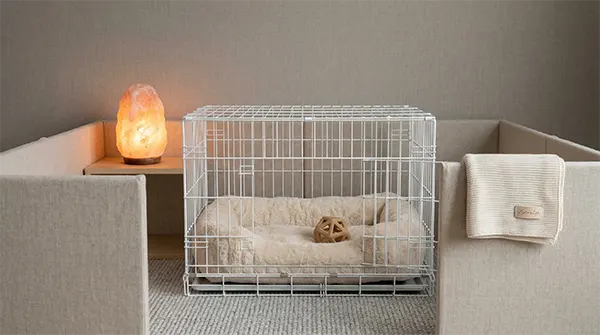
When the biting gets out of control and the puppy seems possessed by chaotic energy, they are usually just exhausted. You must intervene. This is where your crate or playpen setup transitions from a holding area to a “Zen Den.”
You are creating a quiet, dimly lit, safe harbor for them to decompress. When you place a tired puppy in their den, they might protest for a few minutes. However, the overwhelming urge to sleep will usually win out quickly.
During these precious nap times, you must aggressively guard your own peace. Do not use this time to frantically clean the house or catch up on chores. Sit down, drink some water, and let your own nervous system reset.
Establishing the Non-Negotiable Boundaries
Surviving the first month with a new puppy is not about being strict; it is about being entirely predictable. Puppies thrive on consistent rules. If jumping on the couch is not allowed today, it cannot be allowed tomorrow just because you are too tired to correct it.
The more predictable their world is, the faster their anxiety drops. They learn that certain actions always yield positive results, while other actions yield nothing. Your attention is their highest currency right now.
When the needle teeth make contact with your skin, the interaction must immediately end. A sharp yelp, standing up, and turning your back removes the one thing they want: you. Consistency in this reaction is the only way to teach bite inhibition.
It feels tedious to repeat these steps fifty times a day. But this repetitive foundation is exactly what builds the calm, confident adult dog you are dreaming of.
The Reality of Midnight Potty Training
There is a very specific type of exhaustion that comes from standing in wet grass at 3:00 AM. You are shivering, your German Shepherd puppy is stubbornly chewing on a leaf, and you are desperately praying for them to just go to the bathroom. Surviving the first month with a new puppy often feels like an endless cycle of sleep deprivation.
A young puppy’s bladder is incredibly small, and their physical control over it is non-existent. Expecting them to hold it through the night during those first few weeks is simply setting both of you up for failure. You have to beat them to the punch by setting proactive alarms.
When that alarm goes off, the interaction must be entirely strictly business. Do not turn on all the bright lights, do not use an excited voice, and absolutely do not engage in playtime. You want to carry them to their spot, use your chosen cue word, and wait.
If you find yourself staring at the ceiling at 4 AM, wondering how to structure these wake-ups without losing your mind entirely, you need a concrete plan. I mapped out the exact, hour-by-hour sleep and potty schedules in The First 30 Days: A Boutique Puppy Parenting Guide to help you gently phase out those midnight wake-ups and reclaim your rest.
Managing the Indoor “Pu-pocalypse”
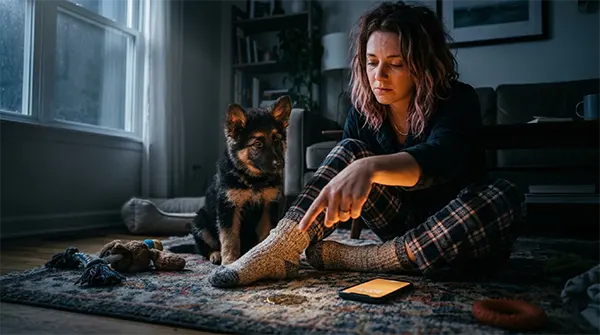
Accidents are going to happen inside the house, and it is crucial not to lose your temper when they do. Finding a puddle on your expensive rug is incredibly frustrating. However, punishing a puppy after the fact does absolutely nothing but teach them to fear you.
If you catch them in the act, a sharp, interruptive noise like an “Ah-ah!” is enough to pause them. Immediately scoop them up and carry them outside to finish. When they finish outside, you throw an absolute party with high-value treats and quiet praise.
Surviving the first month with a new puppy means accepting that indoor accidents are usually a human error, not a puppy error. It means we missed the subtle cues. We missed the sudden sniffing, the circling, or the sudden disengagement from a toy.
Tethering your puppy to you with a lightweight leash indoors is an incredible management tool during this phase. If they are attached to you, they cannot sneak off behind the sofa to relieve themselves. You become hyper-aware of their body language.
Socialization (The Gentle, Boutique Way)
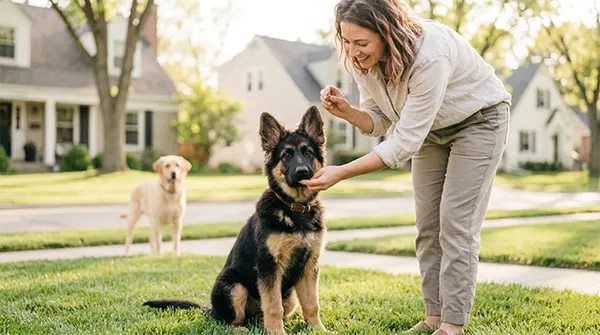
The word “socialization” is thrown around constantly, but it is deeply misunderstood by many new pet parents. It does not mean letting your young German Shepherd puppy meet every single dog or human they see on the street. In fact, forced, chaotic greetings can actually create the exact reactivity we are trying to avoid.
True socialization is about controlled, positive exposure to novel stimuli. It is about teaching your puppy that the world is a safe, neutral place, and that they can look to you for guidance when they feel unsure. You want them to observe the world without feeling pressured to interact with it.
Much like establishing a calming, predictable evening routine for children—a concept we explore deeply in our 7 Proven Sibling Storytime Strategies guide—your puppy needs structured, safe exposure. You are the buffer between them and an overwhelming environment.
Taking your puppy to a busy dog park during their first month is a recipe for a behavioral disaster. Instead, carry them in a safe tote bag outside a quiet coffee shop. Let them hear the sounds of traffic, see bicycles passing, and smell the environment from a place of absolute safety.
Recognizing Overstimulation and Retreating
It is your job to advocate for your puppy’s personal space. When a stranger approaches on the street and asks to pet your dog, you have every right to say, “We are actually in training right now, so please ignore him.” Surviving the first month with a new puppy requires you to be their confident protector.
Watch their body language closely during these short outings. If they are yawning excessively, licking their lips, or trying to hide behind your legs, they are over threshold. That is your immediate cue to retreat and end the session on a positive note.
Every positive, quiet exposure builds a deposit in their “confidence bank account.” Small, five-minute sessions of simply watching the world go by are infinitely more valuable than an hour of chaotic, stressful interactions.
Finding Your New Normal

Around the fourth week, a subtle shift begins to happen in your home. The frantic, shark-like biting starts to decrease just a fraction, and your German Shepherd puppy begins to actually look at you for direction. You will notice brief moments of genuine, quiet connection that make the exhaustion suddenly feel worth it.
Surviving the first month with a new puppy means you have successfully navigated the hardest transition. They recognize their crate as a safe space, they understand the basic rhythm of your day, and you have learned to read their subtle body language. You are no longer just reacting to their chaos; you are proactively managing their environment.
As their confidence grows, so does their curiosity. They will begin testing boundaries further away from your immediate supervision. Before you allow them any expanded access to your living areas, it is critical to thoroughly review The Invisible Threats: A Room-by-Room Guide to Hidden Pet Toxins to ensure their new exploratory zones are genuinely safe.
You will also start to notice their physical growth accelerating rapidly. Providing proper nutrition during this critical developmental window is vital. According to the clinical nutrition experts at the Cummings School of Veterinary Medicine at Tufts University, maintaining a lean body condition during these early months is crucial for large breeds to prevent long-term orthopedic issues.
The Light at the End of the Tunnel
There will still be hard days ahead. There will be days when they mysteriously forget their potty training, or when they decide the baseboards look like a delicious snack. Puppy development is rarely a straight, upward trajectory; it is a series of incredible breakthroughs followed by frustrating regressions.
When you hit a regression, do not panic. Go back to the absolute basics. Tighten up the schedule, increase the enforced naps, and heavily reward the behaviors you want to see. Your consistency is the anchor they need when their rapidly developing brains feel overwhelmed.
You are no longer a stranger to them. You are their provider, their protector, and their ultimate source of comfort. The frantic, sleepless nights of the first week are firmly in the rearview mirror.
Take a moment to look at the sleeping puppy at your feet. Acknowledge how incredibly hard you have worked to get to this point. You have established a foundation of trust that will last for the next decade.
Conclusion: You Are Building a Legacy

You did not just buy a dog; you made a commitment to raise a family member. The overwhelming stress of the first thirty days is the temporary price of admission for a lifetime of unconditional loyalty. Surviving the first month with a new puppy is a badge of honor for any dedicated pet parent.
The needle teeth will soon fall out, the midnight potty runs will become a distant memory, and this chaotic little creature will mature into the magnificent, steadfast companion you always dreamed of. Give yourself some grace, pour another cup of coffee, and trust the process.
You have absolutely got this. Welcome to the incredibly rewarding, exhausting, beautiful world of puppy parenthood.